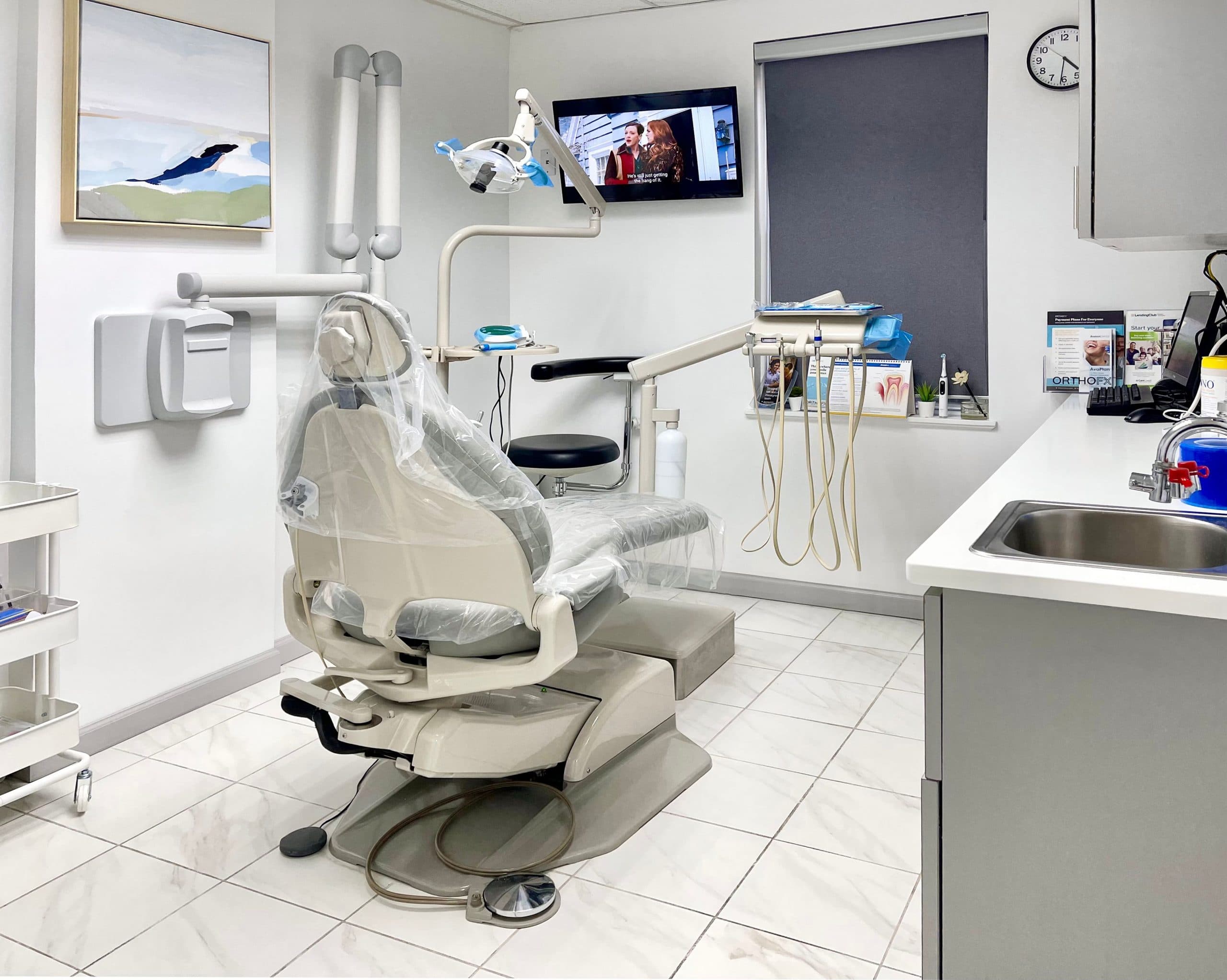
A wisdom tooth extraction takes about 20 to 30 minutes for a single tooth and about 45 to 60 minutes for all four. The whole office visit runs longer than the surgery itself, usually 90 to 120 minutes once check-in, numbing, and the first stretch of recovery are counted. Below we break down where those minutes go, what makes one case faster than another, why upper wisdom teeth come out quicker than lower ones, and how long the recovery takes day by day, from the first 24 hours through full healing.
How Long Does a Wisdom Tooth Extraction Take?
A wisdom tooth extraction takes 20 to 30 minutes for one tooth and 45 to 60 minutes for all four teeth in a single appointment. That is surgical time, measured from the first incision to the last stitch.
Straightforward cases finish faster than the range suggests. In a prospective study of 135 healthy adults published in BMC Oral Health, the extraction phase alone averaged 9.44 minutes per lower wisdom tooth, with a full range of 6 to 25 minutes. The wider 45 to 60 minute figure covers everything around that core: anesthesia, positioning, closing, and moving from one quadrant to the next.
Wisdom teeth, also called third molars, are the last teeth to arrive, usually erupting between ages 17 and 25 into a jaw that often has no room left for them. Removing them is one of the most common surgical procedures in the country. The American Association of Oral and Maxillofacial Surgeons estimates roughly 10 million wisdom teeth are extracted from about 5 million Americans every year, and claims data published in Frontiers in Dental Medicine shows about half of privately insured young adults have had at least one removed by age 25, rising to roughly 70 percent by age 60.
How Long Will You Be at the Office?
You will be at the office for about 90 to 120 minutes on the day of a wisdom tooth extraction, which is roughly twice the length of the surgery itself. Patients plan their day around the surgical number and then get caught off guard, so here is where the rest of the time actually goes.
Check-in and final paperwork take about 15 to 20 minutes. Numbing takes about 5 minutes for local anesthesia to take full effect, longer when sedation is involved because the medication needs time to work and the patient needs monitoring afterward. The extraction runs its 20 to 60 minutes depending on the case. Immediate aftercare adds another 5 to 10 minutes while gauze is placed, bleeding is checked, and recovery instructions are reviewed.
Cases done under intravenous sedation or general anesthesia need a longer tail. The patient has to come out of anesthesia gradually, and the surgical team monitors them until they are fully alert and safe to leave. Those visits commonly run 90 minutes to two hours from door to door. At our office we perform extractions under local anesthesia, and we do not offer nitrous oxide or sedation, which keeps the visit closer to the shorter end of the range for most patients.
What Affects How Long a Wisdom Tooth Extraction Takes?
The length of a wisdom tooth extraction is affected by impaction depth, tooth angulation, root shape, which jaw the tooth sits in, how many teeth are removed, the type of anesthesia, and the experience of the surgeon. The first two matter more than all the others combined.
- Impaction depth. A tooth fully erupted through the gum comes out with standard instruments. A tooth buried in bone needs an incision, bone removal, and often sectioning into pieces.
- Angulation. A vertical tooth growing straight up is the fastest. A horizontal tooth lying sideways against the second molar is the slowest.
- Root shape. Straight, fully formed roots lift cleanly. Curved or splayed roots demand slower, more careful work.
- Upper versus lower jaw. Lower teeth take meaningfully longer, for reasons covered in the next section.
- Number of teeth. Four teeth in one sitting take longer than one, though far less than four times as long, since numbing and setup happen once.
- Anesthesia type. Local anesthesia adds about 5 minutes. Sedation adds monitoring time before and after.
- Surgeon experience. A prospective study developing a clinical and radiographic difficulty scale found operation time fell by about 0.45 minutes for every additional year of surgeon experience.
That list sorts every case into one of two categories. A simple extraction removes a tooth that has erupted above the gumline and sits in a workable position, and it is done with elevators and forceps alone. A surgical extraction removes a tooth that is impacted, partially erupted, or broken below the gumline, and it requires an incision in the gum, sometimes removal of bone covering the tooth, and often sectioning the tooth into smaller pieces. Most people need a surgical extraction for at least one wisdom tooth, and full impaction is especially common in the lower jaw.
Measured data shows how much depth alone changes the clock. A cone-beam computed tomography study published in 2026 compared deep and shallow impactions and found deep ones averaged 42.45 minutes against 30.02 minutes for shallow ones, with impaction depth correlating to operative time at a coefficient of 0.901, which is about as strong a relationship as clinical research produces. A separate analysis of 122 patients found horizontal and mesioangular impactions took significantly longer than other angles. The type of wisdom tooth extraction you need is therefore known well before the appointment, because all of it shows on an X-ray.
Worldwide, impaction is common enough that most people fall somewhere on this scale. A systematic review with meta-analysis put the pooled prevalence of impacted third molars at 36.9 percent per person and 46.4 percent per tooth, with lower jaw impaction more frequent than upper.
What Heals Faster, Top or Bottom Wisdom Teeth?
Top wisdom teeth heal faster than bottom wisdom teeth, and they also come out faster, because the upper jaw is made of softer, more porous bone than the lower jaw. This is the single biggest anatomical reason two teeth in the same mouth can have completely different recoveries.
The maxilla, or upper jaw, is largely cancellous bone with a spongy internal structure and a thin outer layer. Cancellous bone flexes slightly under pressure and carries a rich blood supply, so an upper tooth can often be eased out with controlled pressure and the socket heals quickly. The mandible, or lower jaw, is dense cortical bone with a thick, hard outer shell. Cortical bone does not flex, which means a lower tooth usually has to be uncovered and sectioned rather than lifted, and the surrounding bone heals more slowly afterward.
An observational study in Cureus measured this directly by extracting an upper and a lower third molar on the same side in the same 30 patients, one week apart. The lower extractions averaged 44.13 minutes. The upper extractions averaged 33.33 minutes. Same patients, same surgeon, an 11-minute difference driven almost entirely by bone density.
The practical takeaway is that soreness concentrated on the bottom is expected and normal. Lower sockets produce more swelling, more jaw stiffness, and a longer tail of tenderness than upper ones. Patients who have all four removed nearly always report that the bottom two accounted for most of the discomfort.
What Are the Signs Wisdom Teeth Need to Be Removed?
The signs wisdom teeth need to be removed are pain at the back of the mouth, swelling or tenderness in the gum behind the last molar, food trapping around a partially erupted tooth, decay in the wisdom tooth or the tooth next to it, pressure on the neighboring molar, and a cyst forming around the tooth. Some wisdom teeth never cause any of these and can be left alone.
Partially erupted wisdom teeth create the most trouble. A tooth that breaks through only halfway leaves a flap of gum tissue over part of the crown, and that pocket traps food and bacteria in a spot no toothbrush reaches. The result is repeated gum inflammation around the tooth, which can become chronic and start affecting the bone supporting the second molar in front of it.
Decay is the other common trigger. Wisdom teeth sit at the very back of the arch where brushing and flossing are hardest, so cavities form there readily and go unnoticed longer. Caught early, a decayed wisdom tooth might be restored. Caught late, once the decay reaches the nerve, the choice narrows to a root canal on a tooth that is difficult to treat and does little useful chewing, or extraction.
Not every wisdom tooth announces itself. Plenty are found on routine imaging with no symptoms at all, which is why a routine exam with X-rays matters through the late teens and twenties. We take a panoramic X-ray to see the full arch, the angle of each third molar, the depth of impaction, the shape of the roots, and how close those roots run to the nerve canal in the lower jaw. That image determines whether the tooth needs to come out, how long the procedure will take, and what your recovery will look like.
How Do You Prepare for Wisdom Teeth Removal?
You prepare for wisdom teeth removal by arranging a ride home, scheduling the appointment ahead of two low-demand days, stocking soft cold foods in advance, and telling us about every medication and supplement you take. Preparation done the day before removes most of the friction from the day itself.
Medication disclosure comes first. Blood thinners, certain supplements, and some prescriptions change how a socket clots, and clotting is the entire foundation of a smooth recovery. Do not stop taking anything on your own before discussing it with us. Patients receiving sedation are typically asked to fast for six to eight hours beforehand and must have someone drive them home, which is a separate question from local anesthesia and is covered below.
Timing is the piece people underestimate. Schedule the extraction so the two days afterward are as empty as you can make them, since symptoms peak on day two or three rather than on the day of surgery. Buy the soft cold food before the appointment, not after. Yogurt, smoothies, protein shakes, applesauce, and ice cream are the first-day staples, and shopping for them with a numb face and a mouth full of gauze is nobody’s idea of a good afternoon.
Having an Oral and Maxillofacial Surgeon on-site at our Flushing office removes a step for complex cases. Impacted wisdom teeth often require a specialist, and when yours do, the imaging, the surgical plan, and the procedure all stay in one building with one set of records instead of being handed off to an outside practice. You can meet our oral surgeon and the rest of the clinical team before anything is scheduled.
What Happens During a Wisdom Tooth Extraction?
During a wisdom tooth extraction we numb the area, open the gum tissue if the tooth is impacted, remove any bone covering the tooth, section the tooth if needed, lift it from the socket, clean the site, and place stitches and gauze. Here is the sequence with the clock attached to each stage:
- Numbing, about 5 minutes. We give local anesthesia around the tooth and the surrounding gum and bone, then confirm the area is fully numb before starting.
- Opening the site, 2 to 5 minutes per tooth. For an impacted tooth we make a small incision and lift the gum tissue back to expose the crown. Fully erupted teeth skip this step entirely.
- Removing bone, 3 to 8 minutes per tooth. Where bone covers part of the tooth, we remove a conservative amount to create access. Deep impactions need the most.
- Sectioning the tooth, 2 to 6 minutes per tooth. Rather than forcing a tooth out whole and stressing the surrounding bone, we divide it into pieces and remove them one at a time. This step looks like it should add time, and it usually saves it.
- Lifting the tooth out, 1 to 5 minutes per tooth. We loosen the tooth with elevators and lift it from the socket. Straightforward teeth come out in under a minute.
- Cleaning the socket, 1 to 2 minutes per tooth. We irrigate the site and remove any remaining tissue fragments so the socket starts clean.
- Closing and packing, 3 to 5 minutes. We place stitches where they are needed, set gauze over the sockets, and have you bite down with firm steady pressure.
We usually work one side of the mouth at a time rather than jumping between quadrants, which makes bleeding and swelling easier to manage. Everything above falls under oral surgery and is planned from the panoramic X-ray before you sit down, so nobody is improvising.
One finding is worth carrying into the rest of this article. A secondary analysis of a randomized clinical trial in 122 patients found that surgical duration independently predicted how much pain patients had afterward, at roughly 0.03 points of additional pain per minute of surgery. The length of your procedure is not just a scheduling detail. It is the best available predictor of how the next several days will feel.
Is It Safe to Drive After a Wisdom Tooth Extraction?
It is safe to drive after a wisdom tooth extraction performed under local anesthesia alone, as long as you feel steady and alert. Local anesthesia numbs the mouth without affecting judgment, reaction time, or coordination.
Sedation is a different answer entirely. Anyone who receives intravenous sedation or general anesthesia cannot drive for at least 24 hours and must have someone take them home from the appointment. The medication clears slowly, and feeling alert is not the same as being alert.
Numbness from local anesthesia typically lasts a few hours after the procedure. Lips, cheek, and tongue stay numb longest, which makes it easy to bite the inside of your cheek without noticing, so eat carefully until full feeling returns. Numbness that persists past 12 hours is worth a phone call to us.
What Should You Do in the First 24 Hours?
In the first 24 hours after a wisdom tooth extraction you should protect the blood clot, apply cold compresses, eat cold soft foods, rest, and skip brushing the first night. Everything in this window is organized around one goal, which is keeping the clot that forms in each socket exactly where it is.
That clot is the biological scaffold the socket heals on. Dislodge it and you expose bare bone, which is both painful and slow to recover from. So no straws, since the suction pulls clots loose. No forceful rinsing or spitting. No smoking. No strenuous activity for the first 24 hours, since raising your blood pressure restarts bleeding.
For swelling, use a cold compress on the outside of your face for 15 minutes on and 15 minutes off, repeated as needed through the first day. Starting at hours 24 to 48, switch to warm compresses, which then help rather than hurt. Keep your head elevated on extra pillows while you rest, and eat cold soft foods through the first day: protein shakes, smoothies, yogurt, and milkshakes all work well. Skip brushing entirely the first night so the clots can set undisturbed, and start gentle warm salt water rinses the next day, three to four times daily, letting the water sit and fall out rather than swishing. Our full written post-op instructions go home with every patient and cover the whole protocol in order.
Why Is Day 3 the Worst After Wisdom Teeth Removal?
Day 3 is the worst after wisdom teeth removal because swelling peaks 48 to 72 hours after surgery rather than immediately, so your face looks and feels worse two to three days later than it did on the day of the extraction. The surgery is over, and the body’s response to it is only just reaching full volume.
The mechanism is straightforward inflammation. Surgical trauma triggers a cascade that widens local blood vessels and lets fluid move into the surrounding soft tissue. That fluid accumulates over roughly two days before drainage catches up with production, which is why the peak lags the cause. Swelling of some degree is close to universal: the BMC Oral Health prospective study recorded mild to moderate swelling in approximately 94 percent of patients.
Stiffness compounds the feeling. Trismus, the medical term for limited mouth opening, affected 65 of the 135 patients in that same study, roughly half. Trismus comes from the chewing muscles guarding against pain and from swelling physically restricting the jaw, and it peaks on the same 48 to 72 hour curve as the swelling does. So on day 3 the face is at its puffiest, the jaw opens least, and both are entirely normal.
The timeline below draws on the prospective recovery studies cited above together with the clinical recovery sequences published by Cleveland Clinic and Aspen Dental.
| Time Period | What Is Happening in the Socket | What You Will Feel | What You Can Do |
|---|---|---|---|
| Day 1 (first 24 hours) | Blood clot forms and stabilizes in each socket | Numbness for a few hours, light oozing, soreness building as anesthesia fades | Cold compress 15 on and 15 off, cold soft foods, rest, no brushing that night |
| Days 2 to 3 | Inflammatory response peaks; clot organizes into early tissue | Maximum swelling and jaw stiffness, peak soreness, possible bruising | Switch to warm compresses, warm soft foods, gentle salt water rinses, stay home |
| Days 4 to 7 | Swelling drains; soft tissue begins closing over the socket | Noticeably less pain and swelling each day, jaw opening improving | Return to light activity and desk work, expand the diet gradually |
| Week 2 | Gum tissue closes over the socket; dissolvable stitches break down | Most symptoms gone, sockets still tender to direct pressure | Most normal foods, resume exercise, gently brush near the sites |
| Weeks 3 to 4 | New gum tissue covers the sockets completely | Occasional mild tenderness at most | Full normal diet and routine, including crunchy and chewy foods |
How Long Does Pain Last After a Wisdom Tooth Extraction?
Pain after a wisdom tooth extraction lasts about 3 to 5 days at a level that needs managing, and fades to mild tenderness over the following week. The curve rises through day 2 or 3 and then drops steadily.
The numbers back that shape. In a prospective study of 163 patients undergoing surgical removal of impacted lower wisdom teeth, 66 percent reported only mild pain by postoperative day 7 and 32 percent reported no pain at all, leaving just 1 percent with moderate pain and 1 percent with severe pain a week out. Pain past a week is the exception rather than the pattern.
Jaw ache is a separate sensation from socket pain and it confuses people. A dull, tired soreness across the jaw joint and the muscles in front of the ear comes from holding the mouth open during surgery and from the chewing muscles tightening afterward. That ache often outlasts the socket pain by several days and eases as trismus resolves and normal jaw movement returns.
Take pain medication on the schedule we give you rather than waiting until discomfort builds, since staying ahead of pain controls it with less medication than chasing it does. Your written instructions list exactly what to take and when. Pain that intensifies after day 3 instead of easing is the one pattern that does not fit the normal curve, and it usually points to the problem covered two sections below.
How Long Does Swelling Last After a Wisdom Tooth Extraction?
Swelling after a wisdom tooth extraction lasts about 5 to 7 days, peaking at 48 to 72 hours and then declining steadily. Most of the visible puffiness is gone by the end of the first week.
Swelling shows up around the cheeks, the jawline, and sometimes under the eyes, and it is usually worse on the side where a lower tooth came out. Bruising can appear alongside it and may take up to four days to surface, which surprises patients who thought they were past the worst of it. Bruising resolves on its own and needs no treatment.
Cold compresses during the first 24 hours limit how much fluid accumulates. Warm compresses from hours 24 to 48 onward help the accumulated fluid drain. Using them in the wrong order works against you, so the switch matters. Swelling that worsens after day 3, or that comes with fever or pus, has stopped being normal healing, and situations like that belong in the same category as other dental emergencies that need a same-day call.
How Do You Prevent Dry Socket, and When Is the Risk Over?
You prevent dry socket by protecting the blood clot, which means no straws, no smoking, no forceful rinsing or spitting, and no strenuous activity during early healing, and the risk is largely over once the socket starts closing at around day 7 to 10. Dry socket, known clinically as alveolar osteitis, happens when the clot breaks down or never fully forms, leaving bone exposed inside the socket.
It is far less common than its reputation suggests. A single-surgeon retrospective study of 3,033 lower wisdom tooth extractions recorded an overall dry socket rate of 2.6 percent, and a separate prospective series of 584 teeth in 445 patients found a relative incidence of 4.6 percent. Published reviews put the rate at 3 to 5 percent for routine extractions, higher for difficult surgical third molar cases. The large majority of patients never encounter it.
The timing is what most people want to know. Under Blum’s standardized definition, which is the one most of the research uses, dry socket pain begins and increases in severity somewhere between 1 and 3 days after the extraction. That means day 4 is late for it to start and day 7 is later still, though not impossible. Risk climbs with age, and the same retrospective study found patients 30 and older had significantly higher rates than patients in their early twenties, with women affected more often than men.
The signature is unmistakable: pain that gets worse instead of better after day 2 or 3, often radiating toward the ear or temple, sometimes with a bad taste. That is not something to wait out. Dry socket is treatable in a short appointment, and we handle it the same way we handle any other dental emergency, by getting you in quickly and relieving the pain.
When Can You Eat Normally After a Wisdom Tooth Extraction?
You can eat normally about two weeks after a wisdom tooth extraction, and you can start eating soft foods the same day. The progression matters more than the endpoint.
Cold soft foods come first, through the first 24 hours: protein shakes, smoothies, yogurt, ice cream, and applesauce. Cold limits swelling and soft requires no chewing near the sockets. From hours 24 to 72 onward, warm soft foods are better than cold ones, since gentle warmth supports circulation to the healing tissue. Mashed potatoes, soup that is warm rather than hot, scrambled eggs, and oatmeal all work at this stage.
From day 4 through the end of the first week, most people add anything they can cut with the side of a fork. Pasta, soft fish, and well-cooked vegetables are comfortable by then. Chew on the side away from the extraction sites for as long as that feels better. By week two, most normal foods are back, and by weeks three to four, crunchy and chewy foods return safely.
Two categories stay off the list longer than people expect. Hard and crunchy foods such as chips, nuts, and popcorn can lodge fragments in an open socket. Sticky foods can pull at healing tissue. Both are worth avoiding until the gum tissue has closed over, which is a week two event rather than a day five one. Stay well hydrated throughout, and drink from a glass rather than a bottle or a straw.
How Long Should You Avoid Smoking, Alcohol, and Straws?
You should avoid straws, smoking, and alcohol for at least the first 5 to 7 days after a wisdom tooth extraction, and longer for smoking if you can manage it. All three attack healing in different ways.
Straws create negative pressure in the mouth, and that suction is one of the most reliable ways to pull a clot out of a fresh socket. The mechanism is purely physical, which is why the rule applies to every drink rather than just cold or carbonated ones. Carbonated drinks earn their own restriction, since the bubbles agitate the socket directly.
Smoking works against healing on three fronts at once. The inhaling motion produces the same suction a straw does. Nicotine constricts blood vessels and cuts the blood supply the socket needs. The heat and chemicals irritate the wound surface. Stopping after surgery shortens healing time and raises the odds of a clean outcome, which is why we ask every patient who smokes to pause for as long as they can.
Alcohol thins the blood, interferes with clot stability, and interacts with pain medication. Alcohol-containing mouth rinses cause the same irritation topically, so skip commercial mouthwashes during healing and use warm salt water instead, a quarter teaspoon in eight ounces of water, three to four times daily.
How Long Should You Take Off Work After Wisdom Teeth Removal?
You should take about 3 to 5 days off work after wisdom teeth removal, and longer if your job is physically demanding. Most people are back to their daily routine by day 5.
Desk work is manageable sooner than that for many patients, often by day 3 or 4, though the swelling peak on days 2 and 3 makes those the two worst days to attempt anything. Physical work is different. Anything that raises your heart rate raises the risk of renewed bleeding, more swelling, and more pain, so jobs involving lifting, exertion, or heat need the full window and sometimes a few extra days.
Schedule accordingly. Booking the extraction for a Thursday or Friday buys the weekend as recovery time and gets the peak days out of the way before the work week resumes, which is how most of our patients commuting in from across Queens and Long Island prefer to handle it. Exercise follows the same logic as physical work, and most people can return to a fitness routine at around 48 to 72 hours, building back gradually rather than all at once.
How Long Does It Take to Fully Heal?
It takes about 3 to 4 weeks for the gum tissue to fully close over the sockets, and several months for the bone underneath to completely fill in. Those are two separate processes on two very different clocks, and conflating them is why patients worry when a socket still feels like a socket at week three.
Soft tissue healing is the part you experience. Over the first two weeks the gum tissue migrates across the opening, and by weeks three to four it has covered the socket entirely. At that point the site looks normal, feels normal, and tolerates any food. Dissolvable stitches break down on their own during week two, and non-dissolving ones come out at a follow-up visit.
Bone healing runs underneath and takes considerably longer. The socket fills with new bone gradually over several months, and the surface contour of the ridge continues remodeling after that. You will not feel any of it. Functional recovery, meaning the point at which you can eat, work, exercise, and live normally, arrives weeks before biological healing finishes.
Keep the follow-up appointment even when everything feels fine. We check that the sockets are closing properly, confirm the sites are free of infection, and remove any remaining stitches. After that, the area goes back into your normal maintenance schedule, and a professional cleaning every six months keeps the second molars in front of the extraction sites healthy, since those teeth spent years being hard to clean with a wisdom tooth crowded against them.
The molars next door deserve particular attention afterward. Years of food trapping against a partially erupted wisdom tooth leave them at elevated risk, and catching the signs of cavities early on those teeth is far easier now that they are finally reachable with a toothbrush.
Every tooth extraction we perform ends with a plan for what comes next, not just instructions for the week ahead.
Frequently Asked Questions
Will I Be OK 5 Days After Wisdom Teeth Removal?
Yes, you will be OK 5 days after wisdom teeth removal, and most people are back to their daily routine by then. Swelling and pain have both passed their peak and are declining noticeably. Prospective study data shows 66 percent of patients report only mild pain by day 7 and 32 percent report none at all, so day 5 usually sits on a clear downward slope.
How Soon Can You Talk After Wisdom Teeth Removal?
You can talk right after wisdom teeth removal, though speech will be awkward while your mouth is numb and while gauze is in place. Keep talking to a minimum for the first 30 to 45 minutes so the gauze stays under steady pressure and the clots set. Speech feels normal again within a day or two, once swelling and jaw stiffness ease.
How Long Will I Be Numb After a Wisdom Tooth Extraction?
You will be numb for a few hours after a wisdom tooth extraction, depending on the anesthetic used. Lips, cheek, and tongue hold the numbness longest, so eat and drink carefully until full sensation returns to avoid biting yourself. Numbness that lasts more than 12 hours should be reported to your dentist.
What Can You Not Do After Wisdom Teeth Removal?
After wisdom teeth removal you cannot use straws, smoke, drink alcohol or carbonated beverages, rinse or spit forcefully, or exercise hard during early healing. Each of those either creates suction or interferes with clot stability, and the clot is what the socket heals on. Brushing the extraction sites also waits, though you keep brushing the rest of your teeth from the day after surgery.
How Long Do Stitches Take to Dissolve After Wisdom Teeth Removal?
Stitches take about one to two weeks to dissolve after wisdom teeth removal, and most break down during the second week without any attention from you. Some will loosen and come away on their own before that, which is normal and not a problem. Non-dissolving stitches are removed at a follow-up visit.
How Long Should You Take Pain Medication After a Wisdom Tooth Extraction?
You should take pain medication for about 3 to 5 days after a wisdom tooth extraction, following the written schedule we send home with you. Taking it on schedule rather than waiting for pain to build controls discomfort with less medication overall. Most patients taper off as they pass the day 2 to 3 peak, and needing medication past a week is worth a call to us.
The Bottom Line
A wisdom tooth extraction takes 20 to 30 minutes for one tooth and 45 to 60 minutes for all four, inside an office visit of roughly 90 to 120 minutes. What drives the variation is impaction depth, tooth angle, and which jaw the tooth sits in, and every one of those is visible on a panoramic X-ray before the day arrives. Lower teeth take longer and heal slower than upper ones because the lower jaw is denser bone, which is the same reason the bottom of your mouth accounts for most of the soreness afterward.
Recovery follows a shape worth memorizing: symptoms peak on day 2 or 3, decline steadily through day 7, and resolve over three to four weeks as the gum tissue closes, while the bone underneath quietly fills in over several months. Protect the clot, follow the written instructions, and call if pain climbs after day 3 rather than falling.
If your wisdom teeth are causing trouble or an X-ray has flagged them, we are happy to look at the imaging and tell you exactly what your case involves and how long it will take.
At Avalon Dental, we would rather give you a real timeline up front than a vague reassurance.
Call us at 347-472-0318 when you are ready, or reach out and we will find a time that works.