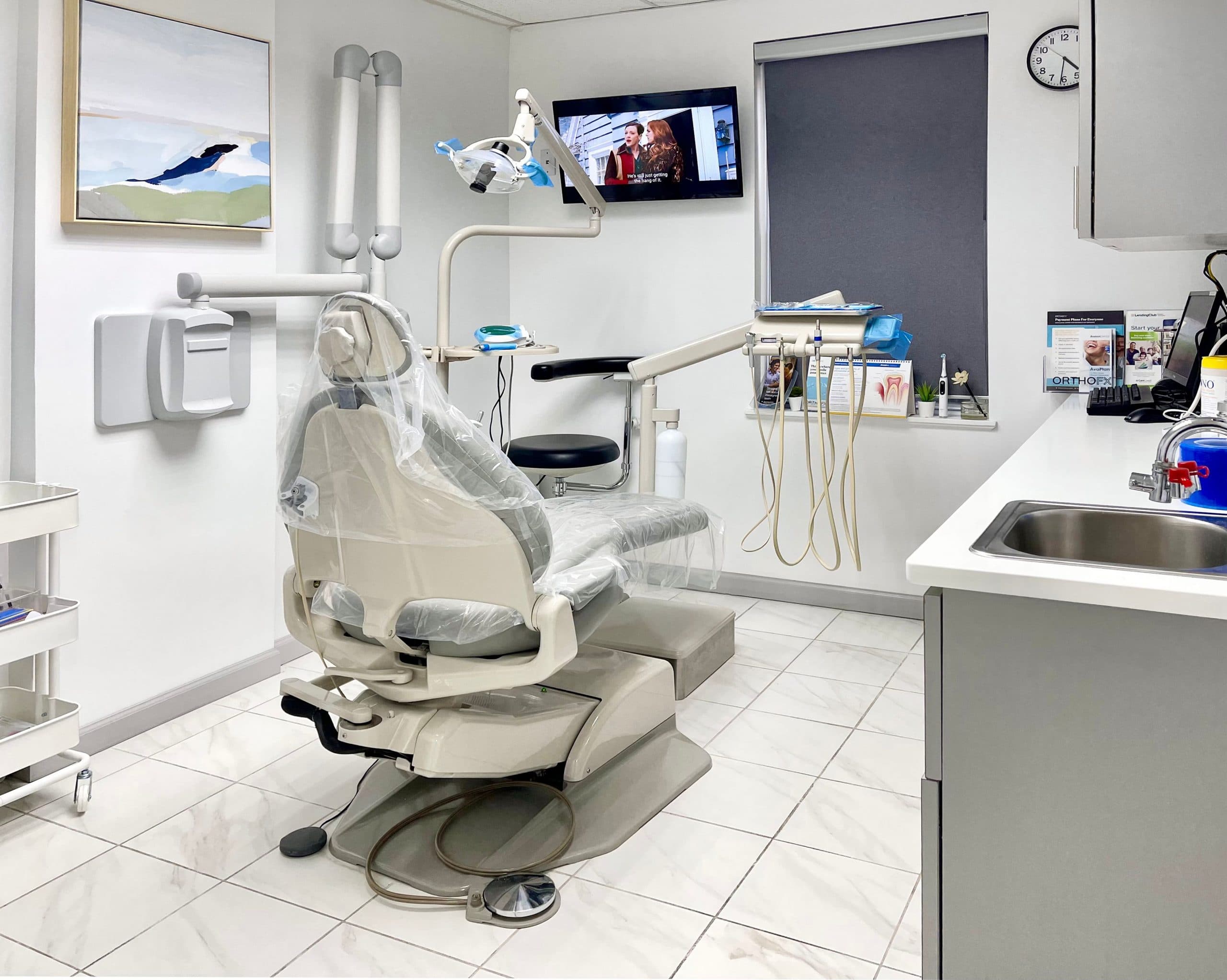
Professional teeth whitening is a cosmetic dental procedure that lightens natural tooth enamel and dentin using a high-concentration peroxide gel applied under a dentist’s supervision. The gel works through oxidation, which means peroxide molecules pass through the porous enamel surface into the dentin underneath and break apart the dark pigment molecules trapped inside the tooth. Professional whitening comes in two forms, in-office treatment performed at the dental chair and custom take-home trays filled with prescription-strength gel. Whitening lightens natural tooth structure only, so crowns, veneers, fillings and bonding keep the exact shade they were made in. Below we explain what the gel contains, how the oxidation process lifts stains, what happens step by step during a whitening visit, how many shades teeth lighten, what the side effects feel like, and how long the brighter color holds.
What Is Professional Teeth Whitening?
Professional teeth whitening is a dentist-supervised cosmetic treatment that uses concentrated hydrogen peroxide or carbamide peroxide to lighten the natural color of your teeth. The word professional points to two things at once: the strength of the bleaching gel and the person controlling it. A dentist can safely place a peroxide gel many times stronger than anything sold at a pharmacy, because the gums, lips and soft tissue are physically protected before the gel ever touches a tooth. That protection is what makes the higher strength possible.
Higher strength is also what separates a cosmetic result from a cosmetic promise. We use professional teeth whitening for patients whose teeth have dulled from coffee, tea, red wine, tobacco or simple aging, and the treatment changes the color of the tooth itself rather than scrubbing the surface. Surface scrubbing removes only what sits on top of the enamel. Enamel-penetrating gel reaches the pigment underneath.
What Makes Professional Whitening Different From Store-Bought Kits?
Professional whitening differs from store-bought kits in peroxide concentration, gum protection and supervision. According to the American Dental Association, over-the-counter whitening products are generally considered safe at hydrogen peroxide concentrations no greater than 3.5 percent. Colgate’s oral care research reports that the hydrogen peroxide used during in-office procedures runs as high as 25 to 40 percent, far above what is considered safe for unsupervised use.
Unsupervised use is exactly where store-bought kits run into trouble. A strip or a boil-and-bite tray cannot seal gel away from gum tissue, so manufacturers keep the concentration low to compensate. Low concentration means the gel needs far more contact time to move the color, which is why research published in the Journal of the American Dental Association notes that most at-home kits advertise visible results only after two to four weeks of daily use.
What Are the Two Main Types of Professional Teeth Whitening?
The two main types of professional teeth whitening are in-office whitening performed at the dental chair and custom take-home trays prepared from a mold of your teeth. In-office whitening delivers the color change in a single appointment. Custom take-home trays deliver the same chemistry at a lower dose over a stretch of nights at home, and the trays are molded to your own arch so the gel stays on the teeth instead of leaking onto the gums.
Gum contact is the reason custom trays outperform the one-size trays sold in boxes. Both types of professional whitening are sold under brand names, and patients often search for a brand rather than the procedure. Zoom, Opalescence and POLA are all in-office and take-home whitening systems built on the same peroxide chemistry, and the differences between them come down to gel concentration, delivery and timing rather than a different scientific mechanism. Our office uses Opalescence and POLA, and every in-office whitening we perform includes a complimentary at-home touch-up tray.
How Does Professional Teeth Whitening Work?
Professional teeth whitening works by oxidation, where peroxide molecules diffuse through the enamel into the dentin and chemically break apart the stain molecules held inside the tooth. The gel does not scrape, sand or coat anything. It changes the chemical structure of the pigment itself, so the tooth reflects more light and reads as whiter. Reflected light is the entire visual effect, which is why a whitened tooth looks brighter rather than painted.
Painting is what whitening toothpaste and polishing do, and both stop at the enamel surface. Peroxide travels deeper because enamel is porous at the microscopic level, with channels that run from the outer surface down to the dentin layer beneath.
What Is in Professional Whitening Gel?
Professional whitening gel contains either hydrogen peroxide or carbamide peroxide as the active bleaching agent, along with thickeners, desensitizers and fluoride in most modern formulas. Hydrogen peroxide acts immediately. Carbamide peroxide acts slowly, because carbamide peroxide is hydrogen peroxide packaged with urea that releases the active agent gradually over several hours.
That gradual release has a conversion rate worth knowing. Published whitening chemistry reviews put the ratio at roughly 10 percent carbamide peroxide releasing about 3.5 percent hydrogen peroxide, which explains why a take-home tray gel labeled 15 to 35 percent carbamide peroxide is gentler than it sounds. A 2019 review by Epple and colleagues notes that the American Dental Association has accepted 10 percent carbamide peroxide for overnight use in custom trays, and that acceptance rests on the slow-release profile rather than on a weak formula.
How Do Peroxide Molecules Break Down Stains?
Peroxide molecules break down stains by splitting the chemical bonds inside chromogens, the dark pigment compounds that collect in enamel and dentin over years of eating and drinking. Chromogens from coffee, tea, red wine and tobacco carry long chains of double bonds, and long double-bond chains absorb light instead of reflecting it, which is what the eye reads as yellow or brown.
Yellow and brown respond best to this chemistry for that exact reason. Peroxide releases unstable oxygen molecules that attack those double bonds and cut the long chains into shorter, smaller pieces. Shorter pieces absorb far less light, so the pigment stops darkening the tooth even though it has not been physically removed. This is also why gray-toned discoloration from certain medications or an old injury responds less predictably, since gray staining does not sit in the same chemical family as everyday food and drink pigment.
What Is LED, Laser or Light-Activated Teeth Whitening?
LED, laser and light-activated teeth whitening describe in-office treatments where a lamp in the blue wavelength range is aimed at the whitening gel during the appointment. Blue wavelengths are used because hydrogen peroxide absorbs light in that part of the spectrum, and the light is applied in timed intervals while the gel sits on the teeth.
What actually drives the shade change is the gel strength and the contact time. A 2012 systematic review by He and colleagues in the Journal of Dentistry found no difference in immediate color change between light-activated and light-free systems when hydrogen peroxide concentrations ran between 25 and 35 percent, and a 2018 network meta-analysis by Maran and colleagues reached the same conclusion across every light type studied. The American Dental Association adds a useful detail about why lights look so impressive in the chair: heat and light dehydrate the teeth, which temporarily exaggerates the brightness, and that portion of the effect reverses over the following weeks. Our protocol treats the light as part of a timed sequence and keeps the focus on gel concentration and contact intervals, since those are the two factors that hold the color after the appointment ends.
What Causes Teeth to Stain in the First Place?
Teeth stain from pigment that settles on the enamel surface, pigment that becomes locked inside the tooth structure, and natural changes to the tooth as it ages. Those three sources split into two clinical categories, extrinsic staining on the outside of the tooth and intrinsic staining within it, and the category determines how brightly a tooth responds to whitening.
Response to whitening is exactly why we assess stain type before recommending a treatment. Patients dealing with surface buildup from daily habits often see a strong result, and anyone researching how to brighten stained teeth benefits from knowing which category their discoloration falls into first.
What Is the Difference Between Extrinsic and Intrinsic Stains?
Extrinsic stains sit on the outside of the enamel and come from things that touch the tooth, while intrinsic stains sit inside the enamel and dentin and come from things that changed the tooth itself. Research by Carey on tooth whitening reports that intrinsic discoloration traces to antibiotic exposure, high fluoride levels during tooth development, thinning enamel with age, and in some cases genetics.
Genetics aside, most daily discoloration falls into the extrinsic group:
- Coffee, black tea and red wine, which carry heavy chromogen loads
- Tobacco in smoked and chewed forms, which drives deep brown surface staining
- Dark sodas, berries, tomato-based sauces, soy sauce and curry
- Plaque and hardened tartar, which hold pigment against the enamel
- Certain mouth rinses used long term
Long-term exposure is the common thread, and each of these responds well to peroxide oxidation. Intrinsic staining responds too, just more slowly and less dramatically, because the pigment is distributed through a thicker section of tooth.
Why Teeth Darken Naturally With Age
Teeth darken naturally with age because enamel thins over decades of chewing and brushing while the dentin underneath it grows thicker and more yellow. Dentin is naturally darker than enamel, and the American Dental Association notes that enamel contains no living cells, so it never rebuilds itself once it wears down.
Wear changes what you see. Thinner enamel is more translucent, and translucent enamel lets more of the yellow dentin show through from below. This is the reason a sixty year old tooth and a twenty year old tooth can carry identical habits and look completely different, and it is also why so much of an older patient’s color change comes from reaching the dentin rather than the surface.
Can Yellow Teeth Be Professionally Whitened?
Yes, yellow teeth can be professionally whitened, and yellow is the color that responds best to peroxide whitening. Yellow discoloration comes from the chromogen chains that peroxide is chemically built to break apart, so yellow-toned teeth typically show the clearest improvement of any stain tone.
Clear improvement depends on the tooth being natural tooth structure, which brings up the two questions patients ask most often once they decide to whiten.
Can 60 Year Old Teeth Be Whitened?
Yes, 60 year old teeth can be whitened, and there is no upper age limit on professional whitening for healthy natural teeth. Older teeth often need more total contact time, because the discoloration lives deeper in the thickened dentin rather than on the enamel surface.
Deeper discoloration also changes how we plan the treatment. We frequently pair a single in-office visit with the take-home tray for patients over sixty, since the extra nights of low-dose gel give the peroxide the extended contact the dentin needs. Older patients also tend to have more existing dental work in the smile, and existing dental work behaves very differently from natural enamel.
Which Teeth Cannot Be Whitened?
Teeth that cannot be whitened are the ones that are no longer natural tooth structure, which means crowns, veneers, fillings, bonding and implant restorations. Porcelain and composite materials are manufactured in a fixed shade, and peroxide has no pigment chains to break apart inside them.
Fixed shades create a practical sequencing issue. If you have porcelain veneers across the front teeth, whitening the teeth behind and beside them will not change the veneers at all.
The same holds for dental crowns, which keep the color they were made in no matter how many whitening sessions the surrounding teeth receive.
Composite restorations behave identically. A front tooth repaired with tooth-colored fillings will hold its original shade while the enamel around it lightens, which is why we whiten first and match new restorations to the finished color afterward.
Who Is a Good Candidate for Professional Teeth Whitening?
A good candidate for professional teeth whitening is an adult with healthy gums, no untreated decay, and natural teeth that have yellowed or dulled from food, drink, tobacco or age. Healthy gums matter because peroxide irritates inflamed tissue far more than it irritates healthy tissue, and untreated decay matters because gel reaching an open cavity causes real discomfort.
Discomfort is avoidable with a simple exam first. The American Academy of Pediatric Dentistry advises against bleaching during pregnancy and for children under sixteen, and patients with heavy restoration work across the front teeth usually get a better outcome from a different cosmetic approach. We sort all of this out at the consultation before any gel is prepared.
What Is the Teeth Whitening Process Step by Step?
The teeth whitening process runs through five steps: shade assessment, cleaning and polishing, gum protection, gel application in timed intervals, and a final rinse with a shade comparison. Every in-office whitening appointment at our Flushing office follows this sequence, and the full visit takes one to two hours from start to finish.
Here is how the visit unfolds:
- Shade assessment. We record your starting color against a shade guide. The VITA classical guide holds 16 natural tooth shades arranged by brightness, and the VITA 3D-Master system holds 26, which gives us a fixed reference point to measure the finished result against.
- Cleaning and polishing. We polish the teeth with pumice to lift surface film and plaque, so the gel contacts enamel directly instead of sitting on debris.
- Gum protection. We place a cheek retractor, then paint a hardening resin barrier or liquid rubber dam along the gumline and between the teeth. This step alone can take up to ten minutes, and it is what allows us to use a gel strong enough to matter.
- Gel application. We coat the visible surfaces with whitening gel and work through timed intervals, commonly three to four sessions of 15 to 20 minutes, removing and refreshing the gel between each one so the peroxide stays active the whole time.
- Rinse and final shade check. We suction and rinse the gel away, remove the barrier and retractor, and compare your finished color to the starting shade on the same guide.
The same shade guide at both ends of the visit is what turns a vague impression into a measured result. Patients who want to see how our whitening treatments fit alongside other smile work can review our full cosmetic services, though the whitening visit itself is self-contained and requires no preparation beyond one thing.
Do You Need a Dental Cleaning Before Teeth Whitening?
Yes, you need a dental cleaning before teeth whitening, because whitening gel cannot penetrate through plaque and hardened tartar. Tartar blocks the peroxide from reaching enamel in the spots where it has built up, and blocked spots stay darker while the clean areas lighten, which produces a blotchy finish.
A blotchy finish is entirely preventable. A professional dental cleaning removes that barrier and lifts a layer of surface stain on its own, so the gel starts from a cleaner, more even surface. Cleaning first also surfaces any cavity or leaking filling that needs attention before gel goes anywhere near it.
How Long Does It Take for Teeth Whitening to Work?
Professional in-office teeth whitening works in a single visit of one to two hours, and you see the color change before you leave the chair. Custom take-home trays work more gradually, with most patients seeing their full result after one to two weeks of nightly wear.
Nightly wear and single-visit treatment reach similar destinations on different timelines, and the choice usually comes down to how soon the brighter color is needed.
How Many Shades Whiter Will Your Teeth Get?
Most of our patients finish one to three shades whiter after a single in-office whitening visit. Shade change depends on the starting color, the stain type and how much contact time the gel gets, so teeth that start darker on the guide often move further than teeth that start close to the light end.
Starting color is the single biggest variable, which is why we measure it first. Patients who want to see what that range looks like on real smiles can browse our before and after gallery.
For a closer look at how shade change reads on camera versus in the mirror, we cover photographed whitening results in more detail separately.
Why the Final Color Settles Over the Next Few Weeks
The final color settles over the next few weeks because the teeth dehydrate slightly during treatment and rehydrate afterward. The American Dental Association explains that heat and light application can initially increase the apparent whitening through dehydration, that this portion reverses with time, and that the true final color becomes visible two to six weeks after the procedure.
Two to six weeks is a normal settling window and not a sign that anything went wrong. We tell patients to judge their result at the one month mark rather than the one hour mark, because the shade visible on the drive home always reads slightly brighter than the shade that lasts.
Is Professional Teeth Whitening Painful?
No, professional teeth whitening is not painful, and the procedure involves no drilling, no injections and no pressure on the tooth. Most patients sit comfortably through the appointment with music or a show, and the only sensation they report during treatment is the retractor holding the lips away from the teeth.
Comfort during the visit is separate from what some patients feel in the day or two afterward, and that difference is worth describing precisely.
What Are the Side Effects of Teeth Whitening?
The side effects of teeth whitening are temporary tooth sensitivity and mild gum irritation, and both resolve on their own within a few days. The American Dental Association reports that transient mild to moderate tooth sensitivity occurs in up to two-thirds of users during the early stages of bleaching treatment, and the American Academy of Pediatric Dentistry places the range of patients reporting post-bleaching sensitivity between 8 and 66 percent across studies.
That range is wide because the protocol strongly influences the outcome. A clinical trial published in the Journal of the American Dental Association found that applying a desensitizing agent before in-office bleaching dropped the share of patients reporting sensitivity from 86.7 percent in the control group to 46.7 percent in the treated group, with no loss of whitening effectiveness. We build those protections into the appointment by using gels formulated with desensitizers, sealing the gumline before any gel is placed, and keeping the contact intervals timed rather than open-ended. Patients prone to sensitive teeth can also start on the lower-dose take-home tray instead, which spreads the same chemistry across gentler sessions.
Does Professional Teeth Whitening Damage Enamel?
No, professional teeth whitening does not damage enamel when it is performed at proper intervals under a dentist’s supervision. Peroxide at professional strength temporarily increases enamel porosity during treatment, and the enamel remineralizes from saliva afterward, which is why fluoride is included in most professional gels.
Supervision is the operative word in that answer. The 2019 review by Epple and colleagues found that repeated whitening, or whitening carried on longer than the recommended duration, can cause permanent enamel damage, and the American Dental Association notes that enamel has no living cells and cannot repair itself once it is worn away. Several things in a professional setting keep that outcome off the table:
- A dentist sets the concentration to the patient rather than to a package insert
- Contact time is timed and supervised instead of left to the patient’s judgment
- Gums and soft tissue are physically sealed before gel placement
- Fluoride and desensitizers are built into the gel formula
- Treatment intervals are spaced out rather than repeated back to back
How Long Do Teeth Stay White After Professional Whitening?
Teeth stay white for several months to about a year after professional whitening, with the exact length depending on diet, tobacco use and home care. Patients who drink coffee, tea or red wine daily land at the shorter end of that window, and patients who avoid heavy staining foods and keep up with cleanings hold their result closest to a full year.
Holding the result is where the take-home tray earns its place, since a short refresh at home resets the color long before a full retreatment becomes necessary.
Do Teeth Turn Yellow Again After Whitening?
Yes, teeth gradually turn yellow again after whitening, because new pigment keeps arriving from everything you eat and drink. Teeth do not snap back to their original shade overnight, and they do not return to normal in a single step. The color drifts slowly as fresh chromogens accumulate in the enamel, which is the same process that darkened them the first time.
The same process also responds to the same solution. Touch-up gel in a custom tray reverses that drift in a few nights, which is why we send every in-office whitening patient home with a tray rather than treating the appointment as a one-time event.
What Are the Do’s and Don’ts After Teeth Whitening?
After teeth whitening, avoid deeply pigmented foods and drinks for the first 48 hours while the enamel pores are still open, and keep up with gentle brushing and flossing throughout. Open enamel pores absorb pigment more readily during that window, so the first two days carry more weight than the two weeks that follow.
Here is what we ask patients to do:
- Stick to lighter-colored foods for 48 hours, such as chicken, rice, pasta without red sauce, yogurt and white cheeses
- Skip coffee, black tea, red wine, dark sodas, berries, soy sauce and tomato sauce during that window
- Avoid tobacco entirely for the first two days, and preferably longer
- Drink through a straw when you return to coffee or tea
- Use a desensitizing toothpaste if your teeth feel sensitive to cold
- Rinse with water after anything acidic or deeply colored
Those same habits protect veneers, bonding and crowns too, which makes cosmetic aftercare a single routine rather than a separate one for every treatment.
How Often Can Teeth Be Whitened?
Teeth can be professionally whitened about once a year, with short touch-up sessions in a custom tray in between. Annual spacing on full treatment gives enamel ample time to remineralize between rounds, which is the central safeguard against the cumulative damage that comes from overuse.
Cumulative overuse is almost always an at-home pattern rather than an in-office one, since patients repeating strips every few weeks have no one tracking the total exposure. Touch-ups in a dentist-made tray follow a set schedule instead, usually one to three nights every few months, which keeps the color steady on a fraction of the total peroxide.
Is Professional Teeth Whitening Worth It?
Yes, professional teeth whitening is worth it for anyone who wants a measurable color change in a predictable timeframe with protection for their gums and enamel. Store-bought products cost less and work on light surface staining, but they cannot deliver the concentration, the sealing or the supervision that produce a controlled multi-shade result.
The controlled result is the difference the table below captures. Figures for peroxide strength come from ADA guidance and from Colgate’s oral care research, while the timelines reflect the clinical ranges reported in the Journal of the American Dental Association and in published whitening reviews.
| Whitening Type | Active Strength | Who Applies It | Time to Visible Result | How Long It Holds |
|---|---|---|---|---|
| In-office whitening | 25 to 40 percent hydrogen peroxide | Dentist, with gums sealed | Single visit of 1 to 2 hours | Several months to about a year |
| Dentist-made take-home trays | 15 to 35 percent carbamide peroxide | Patient, in custom-molded trays | 1 to 2 weeks of nightly wear | Several months with touch-ups |
| Store-bought strips and kits | Up to 3.5 percent hydrogen peroxide | Patient, with no gum barrier | 2 to 4 weeks of daily use | Weeks to a few months |
Reading across those rows, the most effective teeth whitening for deep or long-standing discoloration is the in-office treatment, and the most effective maintenance is a dentist-made tray used on a schedule. Combining the two is what we recommend most often, and it is one of the straightest paths through cosmetic dentistry for a patient whose only concern is color.
Frequently Asked Questions
Is It Worth Going to a Dentist for Teeth Whitening?
Yes, it is worth going to a dentist for teeth whitening, because a dentist can use peroxide concentrations up to ten times stronger than anything sold over the counter. The American Dental Association caps safe unsupervised hydrogen peroxide at 3.5 percent, while in-office gels run 25 to 40 percent. A dentist also seals the gums first, checks for decay that would make whitening uncomfortable, and measures the result against a shade guide rather than a guess.
Does Whitening Toothpaste Work as Well as Professional Whitening?
No, whitening toothpaste does not work as well as professional whitening, because toothpaste removes surface film rather than changing the color of the tooth. Most whitening toothpastes rely on mild abrasives such as baking soda or charcoal, and abrasives can only lift what sits on top of the enamel. Professional gel penetrates into the dentin and breaks down the pigment inside, which is a different mechanism with a different ceiling.
Can You Whiten Your Teeth While Wearing Clear Aligners?
You can whiten your teeth during clear aligner treatment, though most patients get a more even result by whitening after the teeth have finished moving. Crowded or rotated teeth have overlapping surfaces that gel reaches unevenly, and those surfaces become visible once alignment is complete. Patients finishing clear aligners often schedule whitening as the last step of the process.
Can Teenagers Get Professional Teeth Whitening?
Teenagers can get professional teeth whitening in some cases, but the American Academy of Pediatric Dentistry advises against bleaching for children under sixteen. Younger teeth have larger pulp chambers and thinner enamel, which raises the likelihood of sensitivity. Any whitening for a teenage patient should follow a full exam and a conversation about timing.
How Soon Can You Drink Coffee After Teeth Whitening?
Wait at least 48 hours before drinking coffee after teeth whitening, since enamel pores stay open and absorb pigment readily during that window. Coffee carries one of the heaviest chromogen loads of any common drink. Once the 48 hours pass, a straw and a water rinse afterward both reduce how much new pigment settles on the enamel.
Is Teeth Whitening Permanent?
No, teeth whitening is not permanent, because new pigment continues to collect in the enamel from everyday food and drink. Professional results typically hold for several months to about a year, and a few nights of touch-up gel in a custom tray restores the color without a full retreatment. Regular cleanings extend the result further by removing the surface film that pigment clings to.
The Bottom Line
Professional teeth whitening lightens natural enamel and dentin using concentrated peroxide gel that oxidizes the pigment molecules locked inside the tooth. The in-office version delivers that chemistry in a single one to two hour visit with the gums sealed and the shade measured at both ends, and most patients finish one to three shades lighter. Custom take-home trays carry the same chemistry at a lower dose for maintenance, which is why every in-office whitening we perform includes one.
Results hold for several months to about a year depending on diet and home care, sensitivity is temporary when the treatment is supervised, and whitening changes natural tooth structure only, so existing crowns, veneers and fillings keep their original shade. If brighter teeth are on your list this year, we are happy to look at your starting shade here in Flushing and tell you honestly what whitening can do for it. Give us a call or contact us to set up a visit, and we will walk you through your options at Avalon Dental from there.